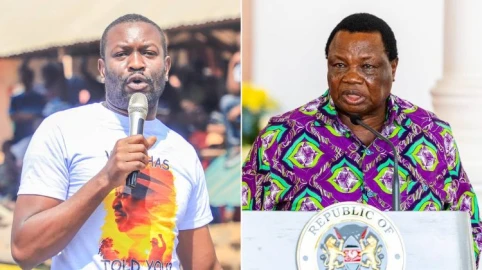
President William Ruto has said the government will not permit a single mining company to control the entire 240,000 acres of land previously allocated for soda ash extraction in Magadi, Kajiado County.
Speaking during a tour of Kajiado West and Kajiado East constituencies on Saturday, Ruto said the government intends to significantly reduce the amount of land available to mining firms. Under the proposed arrangement, companies involved in mining would be allowed to use only about 20 to 30 per cent of the land.
The remaining roughly 70 per cent would be returned to local communities, allowing residents to put the land to other economic and social uses.
According to the President, the new approach is intended to ensure that communities living in mineral-rich areas receive a greater share of the economic benefits generated from resources found within their regions.
The announcement comes as the government prepares to seek a new operator for soda ash mining at Lake Magadi following the end of the long-standing arrangement involving Tata Chemicals Ltd.
Ruto indicated that the government does not intend to continue the previous concession under the same terms. He argued that despite soda ash extraction taking place in the area for close to a century, the benefits reaching local communities and the wider Kenyan economy have not been sufficient.
The President said future agreements would therefore be structured differently, with greater emphasis on protecting national interests and improving the economic position of residents.
One of the major conditions expected to be imposed on companies seeking future mining rights is local value addition. Ruto said investors would be expected to establish processing and manufacturing operations within Kenya rather than simply extracting minerals and shipping them elsewhere in raw form.
Such an approach, he said, could generate employment opportunities, support businesses in Kajiado and contribute to the expansion of Kenya's manufacturing sector.
Lake Magadi contains significant deposits of soda ash, an important industrial mineral used in products including glass and various chemicals.
Ruto argued that Kenya loses considerable economic opportunities when valuable raw materials leave the country without being processed locally. Developing industries around the country's mineral resources, he said, would allow Kenya to retain more of their value while creating jobs and stimulating economic activity.
The President also responded to political leaders who have criticised the government's handling of the Magadi mining arrangement. He rejected arguments that ending the existing agreement would undermine the rule of law, maintaining that investment agreements should also protect the interests of citizens and communities where resources are extracted.
He said Kenya remains open to both domestic and international investment but stressed that future partnerships must provide reasonable benefits to all parties.
According to Ruto, the country wants investors who are prepared to participate in arrangements that promote development rather than agreements focused mainly on extracting resources without providing sufficient benefits to surrounding communities.
He linked the position to a wider argument he has made internationally about Africa's economic relationship with wealthier countries and investors. Ruto said African countries should negotiate partnerships from a position of equality and reject arrangements they consider exploitative.
Land ownership was another issue addressed during his Kajiado tour. The President said the government would speed up the processing and issuance of title deeds to residents.
The initiative is expected to strengthen security of land ownership while enabling residents to make productive economic use of their property.
Ruto's visit also included the launch and inspection of several infrastructure and development projects across Kajiado.
Among them was the 22-kilometre Ngong-Kibiko-Kangiria Road project, whose construction is valued at approximately Ksh.1.4 billion.
The road is expected to provide an important connection between Kajiado and Kiambu counties through Ngong, Kibiko, Kangiria and Gikambura. Once completed, the government expects the route to shorten journeys, lower transportation expenses and improve connections to essential facilities and commercial centres.
Agricultural development was also part of the President's programme.
Ruto launched the second phase of the Nguruman Irrigation Project, an investment estimated at Ksh.560 million. The expansion is expected to place another 2,000 acres of land under irrigation.
Plans for a third phase could eventually expand the irrigated area to approximately 20,000 acres. A dam is also planned to provide water for the expanded irrigation programme, with financing expected through the National Infrastructure Fund.
Another major transport project inspected during the tour was the 72-kilometre Isara-Mashuuru-Imaroro Road. The route serves communities across Kajiado East, Kajiado Central and Kajiado West constituencies.
The President additionally reviewed construction of student accommodation at Kajiado East Technical and Vocational College.
Other projects on his itinerary included the Kitengela Modern Market, which is under construction, and the Kitengela Affordable Housing Project, where development activities are being initiated.
Ruto also defended the government's reliance on the Roads Maintenance Levy to finance road development. He said money raised through the mechanism had helped the government fund thousands of kilometres of road projects while addressing outstanding payments owed within the roads sector.
Healthcare featured prominently in his remarks as well.
The President said approximately 749,000 residents of Kajiado County had enrolled with the Social Health Authority. He added that around Ksh.2.7 billion had been paid to hospitals and other healthcare facilities in the county through the system.
He presented the figures as evidence that the government's healthcare reforms were improving access to treatment and directing resources to medical institutions serving communities.
Turning to education, Ruto said his administration had undertaken several reforms aimed at strengthening the sector.
He cited changes made to the Competency-Based Education system, the recruitment of about 100,000 teachers and the construction of approximately 23,000 additional classrooms across Kenya.
The President concluded his Kajiado tour by urging residents to preserve peaceful relations among the different communities living in the county.
He warned against political campaigns that attempt to mobilise voters through ethnic divisions, arguing that such politics could undermine development and peaceful coexistence.
Ruto also encouraged voters to carefully assess people seeking public office before supporting them.
He said Kenyans should consider the integrity, ability, previous performance and leadership record of candidates rather than making electoral choices primarily on ethnic or other divisive considerations.
The President maintained that responsible management of land, minerals and public investment would be critical to ensuring that development projects and Kenya's natural resources produce tangible benefits for the communities directly affected by them.