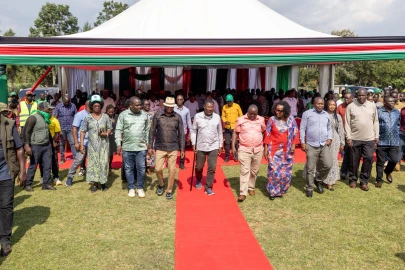
Leaders supporting the broad-based government have defended President William Ruto's performance while questioning whether the opposition has presented a convincing alternative plan for addressing challenges facing Kenyans.
Speaking during separate political and development events across several counties, government-aligned leaders highlighted programmes in agriculture, healthcare, electricity connectivity and the sugar industry as evidence that the administration is making progress.
The leaders also stepped up efforts to build support for Ruto's re-election bid ahead of the 2027 General Election.
National Assembly Speaker Moses Wetang'ula, Deputy President Kithure Kindiki, Energy Cabinet Secretary Opiyo Wandayi, Homa Bay Governor Gladys Wanga and other leaders were among those who addressed gatherings in different regions.
Their activities covered parts of Nyanza, Western Kenya and the Mt. Kenya region, where they promoted the government's development record while challenging opposition leaders to explain what they would do differently.
During a meeting with UDA polling centre officials at Kinoru Stadium in Meru, Kindiki outlined what he described as achievements made by the government since taking office.
The Deputy President placed particular emphasis on reforms within the agricultural sector, arguing that government interventions were intended to increase production and strengthen farmers' incomes.
Kindiki said political debate ahead of the next election should concentrate on practical policies rather than personal rivalries.
He challenged opposition leaders to explain how they would improve agricultural productivity, strengthen healthcare, expand housing programmes and develop markets if elected.
According to Kindiki, those are the issues that should dominate competition between political groups seeking to govern the country.
He also criticised former Deputy President Rigathi Gachagua, questioning his political approach and accusing him of failing to engage constructively on policy matters.
Kindiki called for what he described as greater political maturity as campaigning and coalition-building intensify ahead of the election.
Homa Bay Governor Gladys Wanga also expressed confidence in the broad-based political arrangement.
Wanga argued that opposition groups currently lack the political organisation and leadership required to defeat the alliance supporting Ruto.
She said her assessment of the emerging political contest suggested that the broad-based coalition remained in a strong position.
In Western Kenya, government leaders focused heavily on regional political unity and development projects.
Energy Cabinet Secretary Opiyo Wandayi visited Matayos, where he inspected a last-mile electricity connection programme being implemented by the Rural Electrification and Renewable Energy Corporation.
Wandayi highlighted the benefits of connecting additional homes and businesses to the national electricity grid.
He said expanded electricity access could support businesses, improve household living conditions and create opportunities for communities previously lacking reliable power.
Alongside the development message, Wandayi called for closer political cooperation between Nyanza and Western Kenya.
He argued that voters from the two regions could significantly increase their national political influence by working together.
Wandayi estimated that the combined voting strength of the regions could exceed seven million votes and encouraged residents to consolidate that support behind President Ruto.
According to the Cabinet Secretary, political unity would provide the two regions with a stronger voice in national affairs.
Wetang'ula delivered a similar message, urging communities to work together and avoid divisions that could weaken their influence.
The National Assembly Speaker said greater unity would help communities gain recognition and strengthen their position within Kenya's national political landscape.
The sugar industry was another major subject during the leaders' engagements in Vihiga and Bungoma counties.
Government allies pointed to efforts to revive sugar factories as an important step towards rebuilding an industry that supports thousands of farmers and workers across Western Kenya.
They also called for tougher measures against illegal or excessive sugar imports that could undermine locally produced sugar.
Navakholo MP Emmanuel Wangwe urged authorities to prevent sugar from entering the country through illegal channels.
He argued that protecting the domestic market would allow farmers to supply their sugarcane to factories such as Nzoia and receive greater economic benefits from their crops.
President Ruto's aide Farouk Kibet also addressed the sugar issue.
Kibet said communities in Western Kenya and other parts of the country wanted greater protection for domestic sugar production and were opposed to imports that could disadvantage local farmers.
Government-aligned leaders portrayed the revival of sugar factories as part of a wider strategy to strengthen agriculture and create economic opportunities in regions where sugarcane farming remains an important source of income.
They maintained that operational factories would provide farmers with reliable markets while creating employment and supporting businesses connected to the sugar industry.
The leaders' activities also reflected the increasing political mobilisation taking place ahead of the 2027 election.
While promoting development projects, members of the broad-based government have increasingly used public events to rally voters behind Ruto's bid for another term.
Their message has largely centred on defending the administration's record while demanding that opposition politicians provide detailed policy alternatives.
Government supporters argue that the next election should be based on competing development programmes covering areas such as agriculture, healthcare, housing, infrastructure and employment.
The opposition, meanwhile, has continued criticising the administration on economic, governance and political issues.
As political competition grows, both sides are expected to intensify efforts to build regional alliances and secure support from major voting blocs.
For the broad-based government, cooperation between regions such as Nyanza and Western Kenya appears to be an important component of its emerging electoral strategy.
The presence of leaders at events in Busia, Bungoma, Vihiga, Migori and Meru also demonstrates efforts to strengthen support across different parts of the country.
Government allies say their priority is to maintain development programmes while building a coalition capable of securing another electoral victory for Ruto.
They maintain that progress in sectors including farming, healthcare, electricity access and sugar production provides a foundation upon which the administration can seek another mandate.
With the next election approaching, debates over the government's record and the opposition's alternative policies are expected to become increasingly prominent as both sides compete for support across the country.