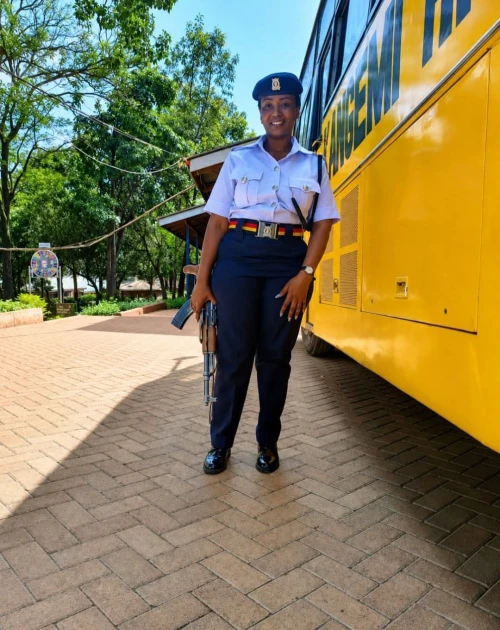
The family of a police officer whose body was discovered in a thicket in Kabete is calling for justice as detectives investigate the circumstances surrounding her death.
Relatives of 46-year-old Sergeant Gladys Nyaguthe Kirika are awaiting the results of a post-mortem examination as well as court proceedings involving the main suspect in the case.
Kirika's sister, Florence Wangui, said the family hopes the medical examination and subsequent legal process will provide answers about what happened before the officer died.
The suspect, identified as Patrick Chege, is currently receiving medical treatment at St. Luke's Hospital in Kinoo.
Police officers are guarding him at the facility as investigations continue. He was hospitalised following what authorities described as an alleged attempt to take his own life.
The case emerged on September 3, 2026, following an unusual development at Kinoo Police Station.
Chege reportedly went to the station and spoke to the deputy Officer Commanding Station.
According to preliminary information available to investigators, he allegedly told police that he had killed his wife before leaving her body in bushes in the Kagira area.
The information prompted officers to begin searching the location mentioned in the report.
Police from Kabete Police Station proceeded to Kagira, where they conducted a search of the surrounding area.
Officers eventually discovered the body of an adult woman hidden within thick vegetation.
Authorities then began examining the scene and attempting to establish the identity of the deceased.
During a search of the body, investigators recovered an official Certificate of Appointment.
The document identified the woman as Sergeant Gladys Nyaguthe Kirika.
Kirika was serving as a police officer attached to Subuiga Police Station in Buuri West Sub-County, Meru County.
Investigators examining the area where her body was recovered found indications suggesting that a violent confrontation may have occurred.
The officer had suffered serious injuries to her head, which investigators initially believed could have been caused by a blunt object.
Injuries were also observed on her left hand.
Detectives additionally discovered significant marks on the officer's legs.
The nature of those marks raised questions about whether she may have been restrained using a rope either before or during the alleged attack.
However, investigators are expected to rely on forensic examination and the post-mortem findings to establish more precisely what happened.
Several items were recovered from the location as part of the investigation.
Among them were a hammer and a Maasai sword.
Police collected the objects as exhibits, and detectives are expected to examine them as they work to determine whether either item was connected to the officer's death.
After investigators completed the initial processing of the scene, Kirika's body was transported to PCEA Kikuyu Funeral Home.
A post-mortem examination is expected to provide important medical evidence concerning the cause of her death and the injuries she sustained.
For the family, the examination represents an important stage in their search for answers.
Relatives want investigators to establish the sequence of events leading to Kirika's death and ensure that anyone found responsible is held accountable through the legal system.
The Directorate of Criminal Investigations has since taken responsibility for the investigation.
Detectives operating through the Dagoretti Division are handling the case and gathering evidence that could eventually be presented before a court.
Investigators are expected to examine evidence recovered from the scene alongside medical findings and other information gathered during the inquiry.
The suspect remains under police watch while receiving treatment.
His appearance in court will depend on doctors determining that he is medically fit to participate in legal proceedings.
Once cleared, Chege is expected to face a murder charge in connection with Kirika's death.
The allegation will then be handled through the judicial process, where prosecutors will be required to present evidence supporting the charge.
Meanwhile, Kirika's relatives continue to await the outcome of the investigation.
The family says it wants a thorough examination of the circumstances surrounding the officer's death and hopes the criminal justice process will establish what happened.
The post-mortem examination is expected to be particularly significant because it could clarify the nature of the injuries and determine the medical cause of death.
Forensic analysis of the items collected from the scene could also assist detectives in reconstructing the events surrounding the incident.
As investigations continue, authorities have not yet publicly established the complete sequence of events leading to Kirika's death.
The DCI inquiry and medical examination are therefore expected to provide further evidence as the case progresses.
The family remains focused on obtaining justice for the slain officer while waiting for investigators and the courts to complete the necessary procedures.